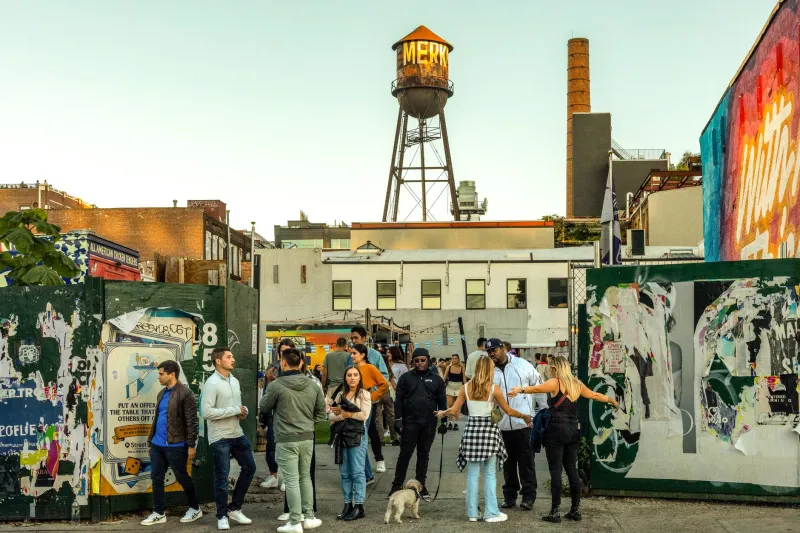
The Two-Hour Escape: How New Yorkers Turned Everyday Nowhere Into the Season's Most Coveted Destination

Photo by Photo by Island Group Studios on Unsplash on Unsplash
Somewhere between the third consecutive weekend of brunch in the same three-block radius and the 47th time someone sent them a link to a Hamptons rental they couldn't afford, a certain kind of New Yorker had a quiet revelation: the city — and everything within two hours of it — is actually full of places they've never been. Places that are, frankly, interesting. Places that are becoming social currency.
This is the micro-adventure moment, and it is having its season.
The New Flex Is Somewhere You've Never Heard Of
Travel has always been aspirational, but the aspirational goalposts keep shifting. For a while, the flex was the international trip — Lisbon, Oaxaca, a remote island that required three connecting flights. Then came the weekend-in-the-Catskills era, all rented farmhouses and artisan coffee shops. Now something different is happening.
The move — and it is absolutely a move — is the hyper-specific, slightly unexpected day trip. Not the obvious getaway. Not the Instagrammed-to-death Hudson or Montauk. The real flex is Bridgeport, Connecticut on a Tuesday. It's taking the LIRR to a town you've passed through 40 times and actually getting off. It's spending a Saturday in Mott Haven like you're a tourist and discovering that you're not wrong to.
The people doing this aren't anti-travel. They're redefining what travel means. And they're doing it with their phones out.
"I've been to Tokyo twice and I'd never been to Rockaway Beach in winter," says Priya, a marketing director in her early 30s who's spent the past year methodically working through what she calls "boroughs I've been sleeping on." "The beach in January is genuinely one of the most beautiful things I've seen in New York. I posted about it and my DMs went crazy."
The Psychology of Going Nowhere Special
There's real psychology behind this movement, and it's worth unpacking. Part of it is economic — international travel is expensive and the post-pandemic price surge hasn't fully corrected. But pure affordability doesn't explain the enthusiasm, the documentation, or the competitive edge that's developed around it.
What's actually happening is a recalibration of what counts as discovery. In a media environment where everywhere worth going has been thoroughly photographed, filtered, and hashtagged into familiarity, genuine newness has become rare and therefore valuable. The overlooked corner of a borough you've lived near for a decade represents real exploratory potential precisely because it's been ignored by the content machine.
There's also a meaningful pushback against the tyranny of the curated trip. The micro-adventure is, by definition, low-stakes. Nothing is riding on it. If the diner in Canarsie turns out to be just a diner, that's fine — you had a diner experience and a train ride and some photographs of industrial waterfront, and you got home by 6pm. The low pressure creates room for genuine surprise.
"When I'm traveling somewhere 'real,' I'm always performing the experience a little bit," admits Marcus, a freelance photographer who's been documenting overlooked corners of the outer boroughs for the past two years. "Day trips feel more honest. I'm not trying to have the trip. I'm just going."
The Destinations Getting Buzz
So where are people actually going? The list shifts constantly, which is part of the appeal, but a few spots have been generating genuine word-of-mouth heat lately.
The South Bronx art corridor — specifically the stretch around Mott Haven and Port Morris — has been quietly accumulating galleries, studios, and food spots for years, but it's hitting a new level of attention from Manhattan and Brooklyn residents treating it like a foreign country they've just discovered. Which, given how rarely they've crossed the bridge, it kind of is.
Asbury Park, New Jersey has been a day-trip staple for decades, but a new generation is rediscovering it with fresh eyes — specifically, people who weren't there for its '90s and 2000s resurgence and are experiencing the boardwalk, the queer culture, and the music scene as genuinely new.
Bridgeport and New Haven, Connecticut are getting traction among the food-obsessed, partly because the New Haven pizza pilgrimage has been well-documented but Bridgeport's own dining scene remains genuinely underreported. The Metro-North ride is 90 minutes. The content potential, apparently, is significant.
Closer to home, neighborhoods like Throggs Neck in the Bronx, Springfield Gardens in Queens, and St. George on Staten Island keep coming up in conversations among people who are deliberately trying to see their own city as a visitor would.
The Social Currency Calculus
Let's be honest about what's also driving this: the posts. There is real social cachet attached to being the first person in your circle to document somewhere before it becomes obvious. The micro-adventure economy runs on being slightly ahead of the curve — finding the lunch spot in a neighborhood that hasn't been profiled yet, photographing the mural before it gets its own hashtag, recommending the ferry route that your friends haven't taken.
This isn't cynical, exactly. The documentation impulse and the genuine curiosity are usually intertwined. People are actually going to these places and actually enjoying them. The fact that they're also posting about it doesn't make the experience less real — it just means the experience has a social afterlife.
"I found this incredible Nigerian spot in Flatbush completely by accident when I was doing a day trip there," says Priya. "I told everyone I knew. That's not content strategy, that's just being excited. The phone was just there."
The Actual Point
What the micro-adventure movement is really about, underneath the social currency and the content strategy, is a genuine renegotiation of what New Yorkers owe their own city. Most people who live here have explored maybe 15% of it with any real attention. The rest is backdrop — passed through on the way to somewhere else, glimpsed from a train window, known only by reputation.
The day-trip era is an invitation to pay attention. To get off at the stop you always skip. To eat at the place with no Yelp reviews. To take the long way home through a neighborhood that doesn't have a nickname yet.
The city is enormous and mostly unexplored, even by the people who think they know it. That's not a problem. That's the whole adventure.
Pack light. Charge your phone. Go somewhere you've never been.
It might be 20 minutes away.