No Apologies, All Flavor: The Second-Gen Chefs Rewriting NYC's Fine Dining Rulebook
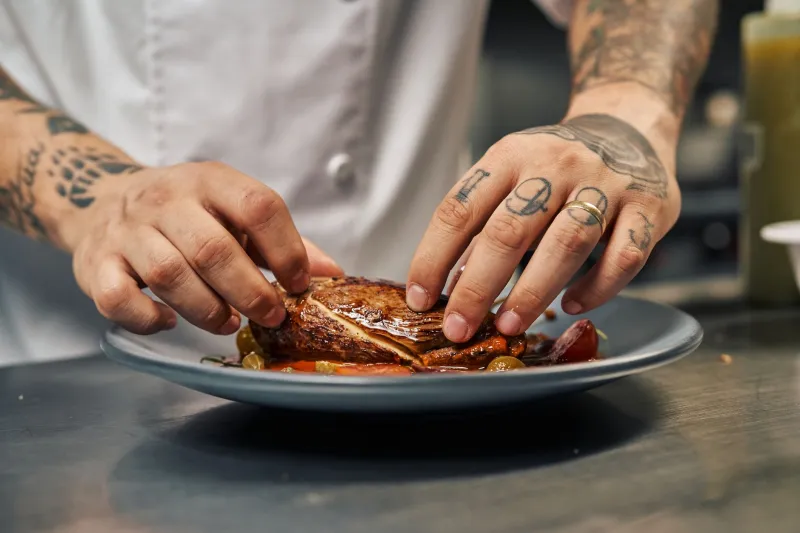
There's a dish on the tasting menu at a small, reservation-only restaurant in Jackson Heights that stops people mid-conversation. It's a slow-braised goat served in a shallow pool of sauce that takes three days to make, finished tableside with a pour of aged vinegar from a bottle the chef's mother brought from the Philippines. It's not fusion. It's not "inspired by" anything. It's a memory, plated with the kind of precision that used to be reserved for food that had nothing to do with where the cook actually came from.
That's the shift. And if you've been paying attention to what's happening in NYC's restaurant world lately, you already feel it.
The Old Rules Don't Apply Anymore
For a long time, there was an unspoken contract in American fine dining. If you were a chef whose family came from somewhere else — the Philippines, Nigeria, Bangladesh, Colombia, wherever — you had two options. You could cook "French-inspired" food and quietly leave your background at the door. Or you could open a "ethnic" restaurant, which meant casual, meant cheap, meant a certain ceiling on how seriously the food world would take you.
That contract is being torn up, slowly and loudly, by a cohort of second-generation chefs who grew up eating extraordinary food at home and spent years watching that food get treated as lesser-than by the gatekeepers of prestige dining. They're done with that. And they're cooking like it.
"My mom made food that would make any Michelin-starred chef cry," says one chef — she asked we not use her name ahead of her restaurant's official announcement — who trained at some of the most decorated kitchens in New York before deciding to open something entirely her own. "The idea that I needed to leave that behind to be taken seriously was never something I fully accepted. I just had to get to a place where I had enough power to push back."
Reclaiming the Narrative
What makes this moment different from previous waves of "multicultural" dining trends is the refusal to translate. Earlier generations of immigrant restaurant owners often softened flavors, adjusted spice levels, swapped out unfamiliar ingredients — not because they wanted to, but because survival in the American restaurant market seemed to demand it. The second-gen chefs coming up now are largely rejecting that compromise.
Chef David Osei, who runs a tasting menu concept in Crown Heights drawing on his Ghanaian heritage, puts it plainly: "I'm not here to make you comfortable with my culture. I'm here to share it. If you come to my table, you're coming to my table. The kelewele is going to be spiced the way my grandmother spiced it. The fermented locust beans are going to be in the dish. I'm not hiding anything."
Osei's restaurant, which operates out of a converted brownstone dining room with just 14 seats, has been booked solid for months. His clientele is as diverse as the city itself — and notably, it includes a lot of Ghanaian New Yorkers who've told him they've never seen their food treated with this level of ceremony.
That last part matters. A lot.
Who Fine Dining Is Actually For
One of the most radical things these chefs are doing isn't just what's on the plate — it's who they're inviting to the table. Fine dining in New York has historically been a space that felt coded for a specific kind of customer: wealthy, white, and culturally fluent in a very particular European tradition. The price points, the service style, the wine programs, the whole atmosphere was designed around a certain guest.
The new generation is deliberately disrupting that. Some are building wine lists that center producers from the global south. Some are training their front-of-house staff to explain dishes in terms of cultural context, not just ingredients. Some are pricing their tasting menus in ways that make them accessible to the communities their food comes from — which is harder than it sounds, given the economics of NYC restaurants, but which several chefs describe as a non-negotiable part of their mission.
"If my cousins can't afford to eat here, something is wrong," says one Bangladeshi-American chef operating a prix-fixe concept in Astoria. "I didn't go through all of this to create another space that excludes the people whose culture I'm cooking."
The Ingredients of a Movement
What's fueling all of this? A few things are converging at once.
The pandemic reshuffled the restaurant industry hard enough that some old hierarchies broke down. Chefs who'd spent years climbing the ladder at established restaurants suddenly found themselves free — and hungry — to do something entirely their own. At the same time, a generation of diners who grew up eating globally, who've traveled, who've had their palates genuinely expanded, is demanding more. They're bored of the same reference points. They want to be surprised.
Social media has also played a real role. These chefs can build an audience and a reputation outside of the traditional review ecosystem — which, for a long time, was the primary gatekeeper deciding whose food was worth serious attention. A stunning plate of Oaxacan mole served in a 12-seat dining room in Bushwick can go viral on a Tuesday and be fully booked by Thursday. The old arbiters of taste have lost some of their power, and the chefs who've benefited most are exactly the ones who were most excluded by that system.
A Different Kind of Luxury
At its core, what these chefs are redefining is the very idea of what makes food luxurious. The traditional markers — French technique, rare European ingredients, a certain kind of austere plating — are being replaced by something more expansive. Luxury, in this new framework, is the three-day sauce. It's the ingredient sourced directly from a family farm in a country most diners have never visited. It's the story behind the dish, told without apology or translation.
It's your grandmother's recipe, served on the best china in the room.
New York has always been a city where the next great thing comes from somewhere unexpected. Right now, it's coming from the kitchens of chefs who grew up between worlds, who learned to cook in two languages, and who are finally — finally — getting to cook in their own voice.
Book the reservation. Go hungry. And leave your assumptions at the door.