Walls That Move: Inside NYC's Subway Art Revolution You're Already Part Of
It's 7:43 AM on a Tuesday. You're on the platform at DeKalb Avenue, half-awake, coffee in one hand, phone in the other. Then something catches your eye — a floor-to-ceiling wheat-paste of a woman with subway maps for irises, staring right back at you. You don't know who made it. You don't know how long it'll last. But for a second, the commute disappears.
That's the whole point.
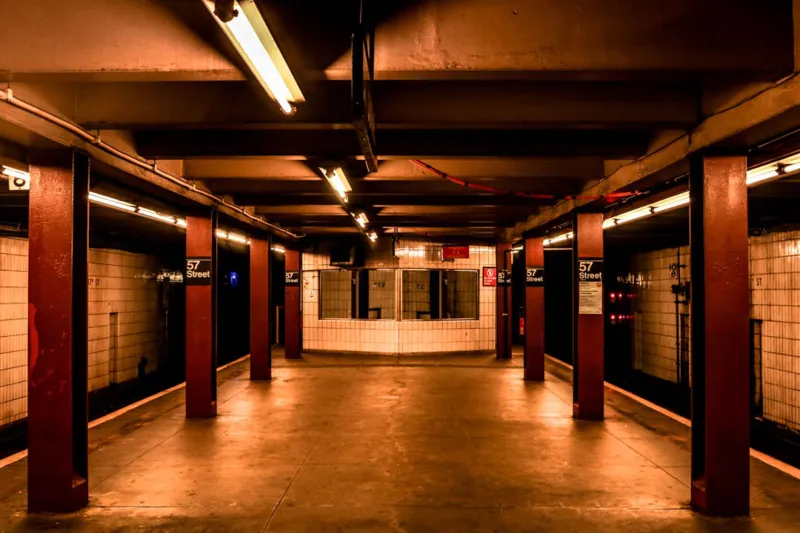
NYC's underground has quietly become one of the most contested and creatively alive art spaces in the country — not because anyone planned it that way, but because artists, commuters, and the city's own chaotic energy all collided in the same tile-covered tunnel. Welcome to the subway gallery. No tickets required. No curator on staff.
The Canvas Nobody Asked For
The MTA has its own official public art program — and it's genuinely great. Commuters at 72nd Street on the 1/2/3 line know the haunting ceramic reliefs by Gregg Lefebvre. Grand Central's ceiling gets all the attention, but the Fulton Center's oculus is pure architectural theater. Official art has its place.
But that's not what we're talking about.
We're talking about the stuff that appears overnight. The intricate hand-lettered poetry taped inside the B train. The small oil paintings — actual framed, gallery-quality paintings — that someone has been zip-tying to support columns in the L train corridor at Union Square for the past two years. The elaborate paper-cut dioramas appearing inside decommissioned phone booths on the A/C/E platform at 14th Street.
These aren't tags. They're not vandalism in the traditional sense. They're interventions — deliberate, thoughtful, and almost always anonymous.
"The subway is the great equalizer," says one Brooklyn-based artist who goes by Marzipan and has been installing work in stations since 2019. "A gallery on the Lower East Side is still gatekept. You have to know it exists. The subway? Everyone's already there. The hedge fund guy and the dishwasher are standing on the same platform."
The Cat and the Mouse and the Tile
Here's where it gets complicated. The MTA does not love unauthorized installations. Legally, any unapproved artwork placed in a subway station falls under vandalism statutes — and enforcement, while inconsistent, is real. Artists who've been caught describe everything from warnings to fines to misdemeanor charges.
The result is an elaborate choreography of timing and strategy. Most guerrilla installations go up between 1 and 4 AM, during the lowest-traffic window before the early morning rush. Artists scout locations weeks in advance, noting camera angles, staff patrol patterns, and which stations have the most tolerant booth attendants. Some work in teams — one person installs while others keep watch at stairwells.
And yet, MTA workers themselves have a complicated relationship with what they find. Multiple transit employees, speaking off the record, described discovering unauthorized art and simply... leaving it. "If it's not a tag and it's not obscene, honestly, sometimes it makes the platform look better," one station agent told us. "People stop and look at it. That's not nothing."
The impermanence is part of the aesthetic. Works that survive a week are considered long-lived. Most disappear within 48 hours — removed by MTA cleaners, damaged by the environment, or occasionally taken by commuters who want a piece for themselves. That ephemerality, artists argue, is precisely what makes subway art more honest than anything hanging in a white-cube gallery.
Commuters as Curators
What's fascinating is how regular New Yorkers have started participating in the ecosystem — not just as passive viewers, but as active agents. Commuter Facebook groups and Reddit threads dedicated to specific subway lines have developed informal documentation practices. Someone spots something new at the Atlantic Avenue-Barclays Center platform, posts a photo, and within hours there's a thread of people sharing sightings, speculating about the artist, and grieving when the piece disappears.
Some commuters have taken it further. A loose network of transit regulars on the G train — already a line with an almost tribal sense of community — have started leaving small creative responses to whatever art appears. A found poem gets a handwritten reply. A portrait gets a tiny complementary sketch pinned beside it. It's a conversation happening in real time across days and weeks, between strangers who will never meet.
"The subway has always been a social space, even when we're all pretending to ignore each other," says Dr. Camille Osei, a cultural studies lecturer at The New School who has been researching transit art movements for the past three years. "What's shifted is that art is giving people permission to actually engage with that space. It breaks the social contract of commuter isolation in the best way."
Beyond the Aesthetic: What It Actually Means
There's a political dimension here that's worth naming. A lot of the guerrilla art appearing in subway stations isn't apolitical. Works responding to housing displacement, police violence, and gentrification appear regularly — and tend to cluster in stations serving neighborhoods undergoing rapid demographic change. The Myrtle-Wyckoff station on the L/M, the Nostrand Avenue stop on the A/C, the 103rd Street station in East Harlem. These aren't random locations.
"The subway is one of the last genuinely public spaces in this city," Marzipan says. "You can't be priced out of the subway platform the same way you get priced out of a neighborhood. So it becomes the place where you say things that the neighborhood used to be able to say for itself."
That's a heavy charge for a wheat-paste on a column. But New York has always processed its identity through its walls.
How to Actually See It
If you want to engage with this world beyond accidental discovery, there are ways in. The Instagram accounts @subwayartwatch and several similar handles have built followings specifically around documenting ephemeral transit art in real time — follow them and you'll start getting tips about what's appeared and where. The unofficial subreddit r/NYCsubwayart operates similarly.
Beyond social media: slow down. The installations that blow commuters away are almost always in the spots people rush past — the transfer corridors, the far ends of platforms, the mezzanine levels nobody uses. The art finds the gaps in your attention and sets up camp there.
The subway has always been New York's great equalizer — the one place where the city's full spectrum shares space and breath and delay. The artists working its tunnels aren't just decorating infrastructure. They're insisting that public space still belongs to the public, one zip tie and wheat-paste at a time.
And honestly? The commute hits different when you're looking for it.